On this page
Author Spotlight: Sonam Wangchuk
The engineer who turned melting glaciers into classroom revolutions
Who was Sonam Wangchuk?
Before there were schools in his village, before there were textbooks or blackboards, Sonam Wangchuk learned to read and write from his mother in the high-altitude desert of Ladakh. Born on September 1, 1966, in the tiny hamlet of Alchi, he spent his earliest years sowing seeds, climbing trees, and jumping in rivers — a childhood steeped not in formal education but in the rhythms of mountain life. At the age of nine, he was taken to a school in Srinagar, where everything changed. He looked different from the other children. He was addressed in a language he did not understand. His silence and confusion were mistaken for stupidity. He has called this the darkest period of his life. Unable to bear the treatment, the eleven-year-old boy escaped alone to Delhi, knocked on the door of a Kendriya Vidyalaya, and pleaded his case — a child asking for nothing more than to be taught with dignity.
That early ordeal forged a conviction that would define his life’s work: education systems, when imposed without cultural sensitivity, do more harm than good. After earning a degree in mechanical engineering from NIT Srinagar — which he financed himself after falling out with his father over his choice of field — Wangchuk did something unusual for an engineering graduate. He founded a school. In 1988, he and a small group of fellow students launched the Students’ Educational and Cultural Movement of Ladakh, or SECMOL, determined to reclaim education for Ladakhi children. What began as a modest volunteer effort grew into Operation New Hope in 1994, a landmark collaboration between government, village communities, and civil society that reformed the government school system across the region. Wangchuk went on to design the SECMOL campus itself — a rammed-earth, solar-powered marvel that runs entirely on renewable energy and won the International Terra Award in 2016.
Wangchuk’s genius lies in his insistence that solutions must come from the ground up — literally. When Ladakh’s farmers faced water shortages because glaciers were melting too early to irrigate spring crops, he invented the Ice Stupa — a cone-shaped artificial glacier that stores winter stream water and releases it precisely when farmers need it. The technique has since been replicated in the Swiss Alps. When his warning about a landslide-blocked lake in Zanskar was ignored by authorities, the resulting flash flood destroyed 12 bridges — vindicating his plea for local knowledge to be taken seriously. His philosophy is a quiet rebellion against the industrial model of education and development: schools should heal the earth, not conquer it. Universities should produce doers, not degree-holders. “Paper knowledge, paper evaluations, paper degrees — all too papery and all too theoretical,” he says. “It has very little that prepares us for real life in the real world.”
Today, Sonam Wangchuk is a Ramon Magsaysay Award laureate, a Rolex Award recipient, and the founder of the Himalayan Institute of Alternatives Ladakh (HIAL), which he describes as a “real-world university.” He has also become one of India’s most visible climate activists, leading hunger strikes for Ladakh’s constitutional protections and enduring house arrest and detention for his advocacy. In September 2025, he was moved to Jodhpur Central Jail after protests in Leh turned violent, an episode that drew international attention to the cost of speaking truth to power. Through it all, his message remains startlingly simple: live simply, learn deeply, and let the mountains teach the world.
Sonam Wangchuk’s most memorable quotes
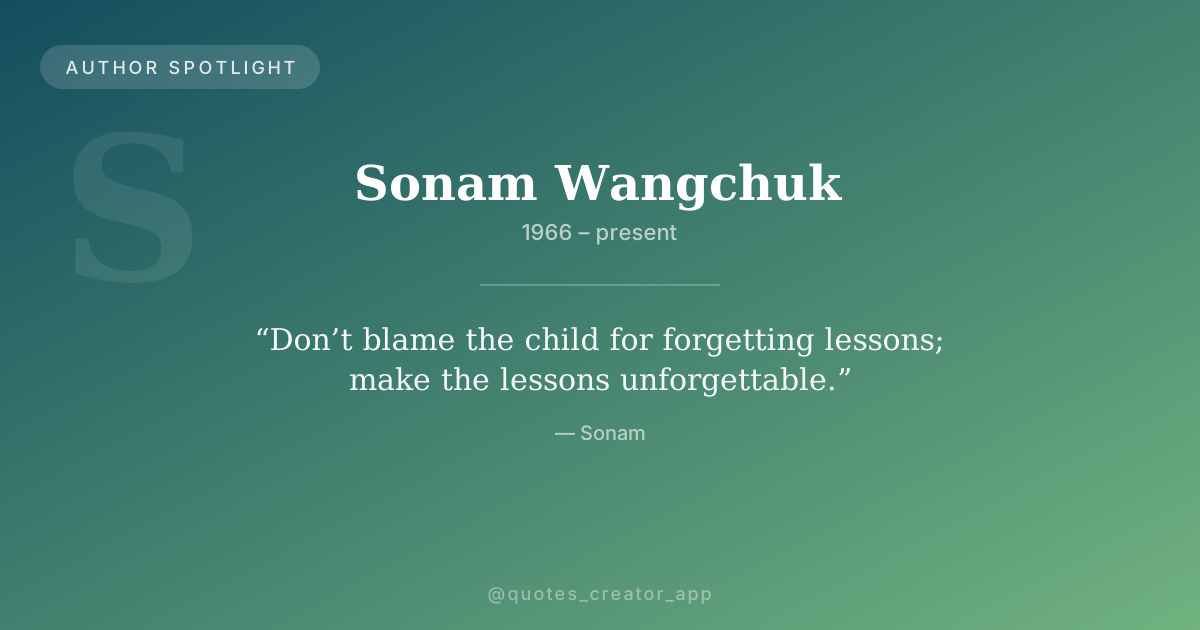
“Don’t blame the child for forgetting lessons; make the lessons unforgettable.”
The meaning behind these words
This single sentence contains Wangchuk’s entire educational philosophy compressed into eleven words. It inverts the traditional power dynamic of the classroom. Instead of asking why the student failed to absorb the material, it demands that the teacher ask why the material was not worth absorbing. Wangchuk learned this lesson painfully as a child in Srinagar, where an alien curriculum delivered in an alien language left him silent and ashamed — not because he was unintelligent, but because the system was indifferent to who he was.
The idea has radical implications. At SECMOL, students learn science by building solar-heated mud buildings. They learn mathematics by calculating the optimal shape of an Ice Stupa. They learn languages by publishing a magazine. When education is tethered to lived experience, it ceases to be a chore and becomes an extension of curiosity. Wangchuk is not asking for flashier teaching methods; he is asking for a fundamental reorientation of what education is for. It is not about producing compliant workers for an industrial economy. It is about producing capable human beings who know how to solve real problems in their own communities.
“I believe that education should be about healing the earth and dealing with the crises that we are in.”
The meaning behind these words
When most people think of education, they think of career preparation — the grades, the degrees, the job placements. Wangchuk reframes the entire enterprise around survival. He points out that the modern education system was forged during the Industrial Revolution, an era that treated nature as an infinite resource to be conquered and consumption as an unlimited good. That model has brought humanity to the precipice of climate collapse, and yet schools continue to operate as if the planet is doing just fine.
At HIAL, the university he is building in Ladakh, every discipline — engineering, agriculture, tourism, design — is taught through the lens of ecological restoration. Students do not just study glaciers; they learn how to build them. They do not just debate climate policy; they design solar-powered infrastructure for remote mountain communities. Wangchuk’s vision is not about adding an environmental studies elective to an otherwise unchanged curriculum. It is about making the healing of the earth the central purpose of every classroom, at every level, everywhere.
“Let Ladakh change the world rather than the world change Ladakh.”
The meaning behind these words
This seven-word manifesto captures the emotional core of Wangchuk’s activism. Ladakh is one of the most fragile and beautiful places on earth — a high-altitude cold desert where traditional life has been fine-tuned to nature over centuries. But climate change, mass tourism, and predatory industrial interests threaten to erase that way of life. Wangchuk’s statement is not parochial pride; it is a strategic reversal of the usual direction of influence. The world expects remote places like Ladakh to modernize — to adopt the cities’ values, their consumption patterns, their definition of progress. Wangchuk insists it should be the other way around.
What would it mean for Ladakh to change the world? It would mean the world adopting Ladakh’s model of solar-powered communities, its respect for water as sacred, its integration of education with ecological stewardship. When Wangchuk built Europe’s first Ice Stupa in the Swiss Alps in 2016, he was not exporting technology; he was exporting a philosophy. The phrase has also become a rallying cry for Ladakh’s autonomy movement, which demands constitutional protections to shield the region from being turned into — in Wangchuk’s words — “a colony for mining and industry.”
“We should choose simple ways of living… to live in harmony with nature by adopting simpler technologies and using natural resources innovatively.”
The meaning behind these words
There is a quiet radicalism in the word “choose.” Wangchuk is not romanticizing poverty or asking anyone to sacrifice comfort. He is making a case that simplicity, done right, is a form of sophistication. At SECMOL, students live in buildings heated entirely by passive solar design, even when outside temperatures drop to minus thirty degrees Celsius. They cook with solar energy. They grow food in greenhouses. None of this feels like deprivation; it feels like liberation from a system that keeps people dependent on fossil fuels and distant supply chains.
What makes his approach distinctive is the emphasis on innovation within simplicity. The Ice Stupa is not a return to some pre-industrial past; it is a clever application of fluid dynamics, heat transfer, and materials science. Similarly, the solar-powered tents he developed for the Indian Army use modern photovoltaic technology to create habitable spaces in some of the harshest terrain on the planet. Wangchuk’s message to the world is that we do not need to abandon technology to live sustainably. We need to abandon the kind of technology that treats the planet as disposable.
“I expect nothing from the government but I expect everything from people.”
The meaning behind these words
This might be Wangchuk’s most surprising statement, coming from a man who has spent years petitioning the government for Sixth Schedule protections for Ladakh, who has been placed under house arrest, who has gone on hunger strike, and who was jailed in Jodhpur for his advocacy. It seems contradictory — until you understand that for Wangchuk, activism directed at the state and expectations placed upon the state are two different things. He fights the government not because he believes it will save Ladakh, but because its policies are obstructing the people who can.
The real engine of change, in his view, has always been ordinary citizens. SECMOL was built by students. Operation New Hope succeeded because village communities took ownership of their schools. The Ice Stupa was crowdfunded. His vision of a better world relies not on policy papers and Five-Year Plans but on the collective choices of millions of individuals — to consume less, to build differently, to teach children with love rather than force. When he tells city dwellers, “please live a simple life in the city so that we can lead a simple life in the mountains,” he is issuing a quiet challenge: you are not a bystander in the fate of distant places. Your daily choices are the policy.
Sonam’s legacy
Sonam Wangchuk’s legacy will not be measured in buildings or ice structures, impressive as they are. It will be measured in the thousands of Ladakhi students who discovered, often for the first time, that their language, their landscape, and their traditional knowledge mattered. Before SECMOL, Ladakhi children were funneled into an education system designed for the plains — an experience Wangchuk himself described as being a “victim of an alien education system.” Today, an entire generation of educators, engineers, and community leaders has emerged from the movement he started, carrying forward the conviction that mountain communities deserve solutions designed for mountains.
Beyond Ladakh, Wangchuk represents something the world desperately needs: a model of changemaking that is neither corporate nor bureaucratic. He did not wait for a government grant or a venture capital round. He started with a handful of volunteers, a mud building, and a refusal to accept that things had to be the way they were. His story insists that the most pressing problems of our time — climate adaptation, educational inequality, cultural erosion — are solvable, but only if we are willing to think differently about what progress looks like. In an age of climate anxiety and institutional distrust, Wangchuk offers a stubborn, evidence-backed optimism: the solutions already exist, often in the very communities most affected by the problems. What is missing is the courage to listen.
Create graphics with Sonam’s quotes
Sonam Wangchuk’s words have a clarity and urgency that make them perfect for quote graphics. Whether you are an educator looking to inspire your students, a climate activist building awareness, or someone seeking daily motivation for purposeful living, Quotes Creator helps you transform these quotes into beautiful, shareable designs with custom fonts, gradients, and layouts. Use our free online quote maker to create stunning images instantly.
Why we chose Sonam
In an era when the word “innovation” has been hollowed out by tech marketing, Sonam Wangchuk restores its original meaning: solving real problems with whatever is at hand. He built a school movement because he knew what it felt like to be failed by one. He invented a glacier because his farmers needed water. He went on hunger strike because the land that shaped him was being sold to the highest bidder. Everything he has done flows from the same source — an empathy so fierce it will not let him look away from suffering. At ThinkPeak Studio, we believe that words can change the world, but only when they are backed by the kind of life Wangchuk has lived. His quotes do not just sound good on a poster. They carry the weight of decades spent in cold classrooms, frozen fields, and jail cells. That is why we chose him for this spotlight.
— ThinkPeak Studio Editorial Team
Create your own quote graphic with this quote
Turn this line into a shareable graphic in seconds — free, no signup needed. For video quotes and 100+ templates, try the Android app.
Advertisement
Enjoyed this article? Get more like it in your inbox.