On this page
Author Spotlight: Tom Holland
From a dyslexic kid in Kingston upon Thames who was bullied for his love of Janet Jackson and ballet, to the youngest actor to lead a Marvel franchise and the star of two of 2026’s biggest films — a journey through the words, the work, and the world-conquering humility of Tom Holland.
Who is Tom Holland?
Thomas Stanley Holland was born on 1 June 1996 in Kingston upon Thames, south-west London, to Nicola Frost, a photographer, and Dominic Holland, a comedian and author. He was the eldest of four brothers growing up in a household where creativity was the family business and storytelling the dinner-table currency. At seven, he was diagnosed with dyslexia. His parents, determined that he receive the individual attention he needed, sent him to a private preparatory school — a financial strain that Holland would later describe as the first sacrifice made on his behalf, and one he has spent his career repaying. As a child, he was drawn to the music of Janet Jackson, dancing around the living room with an instinctive rhythm that caught his mother’s eye. She enrolled him in a Saturday dance class. It was a decision made on a whim — a mother noticing her son’s joy and deciding to feed it — that would alter the trajectory of not just one life but, through the ripple effects of popular culture, the imaginations of millions of children around the world.
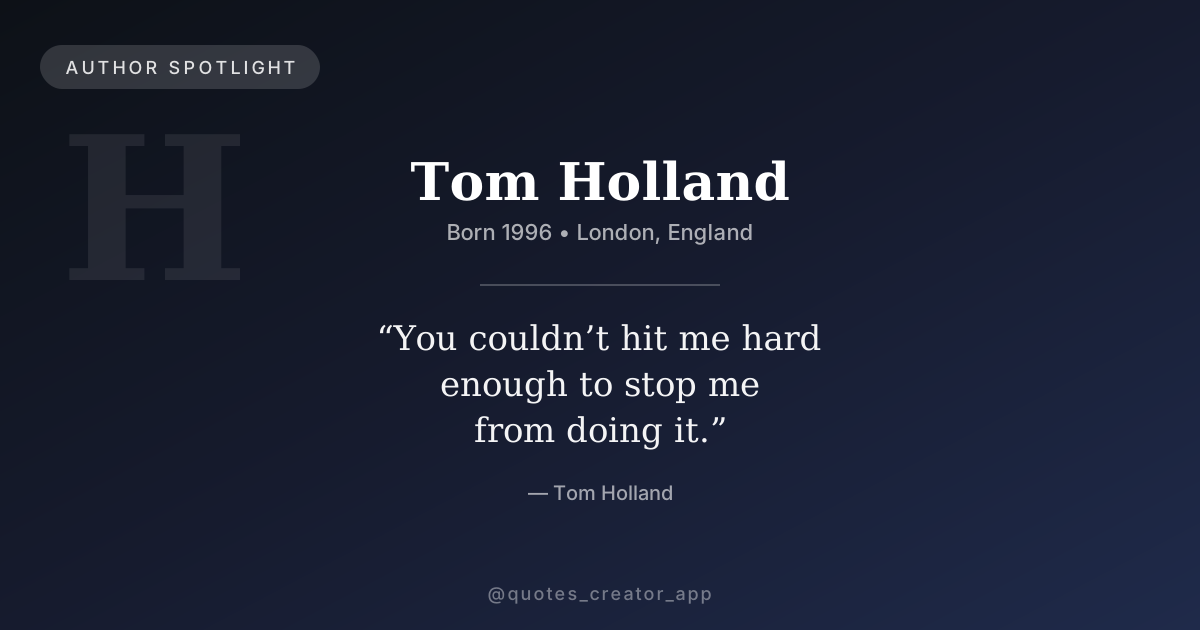
At nine, during a performance with his dance school at the 2006 Richmond Dance Festival, a choreographer named Lynne Page spotted Holland and arranged an audition for Billy Elliot the Musical at London’s Victoria Palace Theatre. After two years of gruelling training — ballet, tap, acrobatics, gymnastics — he landed the role of Michael Caffrey, the protagonist’s best friend, making his West End debut in June 2008 at twelve years old. Months later, he was promoted to the title role. The work was punishing and the reward was complicated: at school, his classmates bullied him for dancing. “There was times when I was bullied about dancing and stuff,” he later said. “But you couldn’t hit me hard enough to stop me from doing it.” This was not bravado. It was the earliest articulation of a principle that would define his career: the thing that made him different — the dancing, the discipline, the willingness to do what other boys wouldn’t — was the thing that would make him indispensable. When his run in Billy Elliot ended in 2010, he was fourteen years old, already a veteran of one of the most demanding stages in the world, and utterly uncertain of what came next.
The answer arrived in the form of a tsunami. Holland sent an audition tape to the Spanish director Juan Antonio Bayona for a role in The Impossible (2012), a disaster drama about a family caught in the 2004 Indian Ocean earthquake. Bayona was so taken with the boy’s emotional rawness that he asked Holland to write a letter to his real mother and recite it on camera. The performance that resulted — of a terrified teenager navigating a devastated landscape with a shattered leg and a missing father — earned comparisons to Christian Bale’s breakout in Empire of the Sun. A. O. Scott of The New York Times called him “a terrific young actor.” The film grossed $180 million, and Holland won the National Board of Review Award for Breakthrough Performance and the London Film Critics Circle Award for Young British Performer of the Year. He was sixteen. He had made one film. And the machinery of Hollywood had already begun to turn in his direction.
In June 2015, after auditioning against 1,500 teenagers worldwide, Holland was cast as Peter Parker / Spider-Man in the Marvel Cinematic Universe. He was nineteen. The character had been played twice before, by Tobey Maguire and Andrew Garfield, each leaving an indelible mark. Holland’s interpretation was different from the start: younger, funnier, more believably adolescent — a kid who high-fived his way through Captain America: Civil War (2016) and whose solo outing, Spider-Man: Homecoming (2017), earned over $800 million and the BAFTA Rising Star Award. His Spider-Man wasn’t tormented; he was thrilled. He wasn’t brooding; he was breathless. The director Jon Watts understood that the secret weapon was Holland’s background in dance and gymnastics — he could perform his own flips, land his own stunts, and move with the physical fluency of someone who had spent his childhood training his body to do impossible things. By the time Spider-Man: No Way Home (2021) became the first film of the pandemic era to cross $1 billion at the box office, Holland had ascended to a tier of stardom that few actors ever reach, and rarely so young. In 2026, he starred in two of the year’s biggest films — Christopher Nolan’s The Odyssey and Spider-Man: Brand New Day — cementing a career that had begun not in a film studio but in a Saturday dance class in Wimbledon, to the sound of Janet Jackson and the quiet, watchful eye of a mother who believed in her son before anyone else did.
Tom Holland’s most memorable quotes
“There was times when I was bullied about dancing and stuff. But you couldn’t hit me hard enough to stop me from doing it.”
The meaning behind these words
This sentence, delivered with the unpolished syntax of a young man recounting his childhood rather than a movie star reciting a script, contains the entire architecture of Tom Holland’s character. He does not say the bullying didn’t hurt. He does not say he rose above it or that he forgave the bullies. He says something simpler and more defiant: that no amount of force applied against him was sufficient to make him abandon the thing he loved. This is not a lesson taught in a self-help book. It is a lesson learned in a body — the body of a boy who had trained for two years in ballet and gymnastics, who understood pain and repetition and incremental progress, and who had discovered, somewhere in the process of becoming Billy Elliot, that the approval of his peers was a currency he could survive without. The quote is powerful precisely because it refuses to sentimentalise the experience. He does not claim to have been strong. He claims only to have been stubborn.
What is remarkable about this statement is how accurately it predicted the arc of his career. Holland would go on to face rejection — losing the role of Finn in Star Wars: The Force Awakens to John Boyega, struggling through the critical failure of films like Chaos Walking and Cherry — and in every instance, the response was the same: keep working, keep training, keep showing up. This is not the resilience of a superhero. It is the resilience of a dancer, someone who has spent thousands of hours in front of a mirror, correcting his own body, failing and correcting again, with no audience but his own dissatisfaction. The bullying, in retrospect, was a kind of unintended gift: it taught him early that the worst thing people can do to you is not fatal, and that the only defeat that matters is the one you accept.
“I often find that superheroes are the bachelors or the billionaires — and everyone loves them. Peter Parker is basically the complete opposite. I just think that’s what a lot of kids feel like as they’re growing up.”
The meaning behind these words
In a genre dominated by billionaire geniuses in armoured suits, demigods from other realms, and super-soldiers created in laboratories, Holland’s observation cuts to the heart of why Spider-Man has endured for over sixty years. Bruce Wayne buys his equipment. Tony Stark builds his. Thor is born to power. Peter Parker is a teenager from Queens who lives with his aunt, worries about rent, gets his suit from a bin, and still finds the moral courage to do the right thing. Holland, who grew up in a financially stretched household in south-west London, understood this instinctively. He was not playing a fantasy of power. He was playing a fantasy of decency — the idea that an ordinary person, given extraordinary ability, might choose to use it not for glory or wealth but because it would be wrong not to. That moral proposition is the engine of every Spider-Man story ever told.
Holland’s phrasing is deceptively casual — “basically the complete opposite” — but the insight is precise. He identifies the gap between what popular culture celebrates and what most children actually experience. Kids are not billionaires. They are not masters of their own destiny. They are small, subject to forces beyond their control, trying to navigate a world built by adults. Spider-Man is the only major superhero whose defining struggle is not against a villain but against the ordinary catastrophes of adolescence: homework, social anxiety, unrequited affection, the gap between who you are and who you want to be. Holland understood that his job was not to be intimidating. It was to be recognisable. And recognition is a more powerful engine of identification than admiration. Every child who watched him swing through New York saw not a god but a mirror.
“The most important thing, in anything you do, is always trying your hardest, because even if you try your hardest and it’s not as good as you’d hoped, you still have that sense of not letting yourself down.”
The meaning behind these words
This is not a quote about achievement. It is a quote about the relationship between effort and self-respect, and the distinction is important. Holland does not promise that trying your hardest will guarantee success. He acknowledges, explicitly, that the result may still fall short of your hopes. The payoff he describes is entirely internal: a “sense of not letting yourself down.” This is a surprisingly mature ethical framework for someone who was still in his early twenties when he articulated it. It shifts the locus of judgment from external validation — the review, the box office, the award — to an internal tribunal that only you can convene. You are the audience that matters most. The applause of others is a bonus, not the point.
The quote also reveals something about Holland’s relationship to failure, which has been a recurring figure in his career. He lost the role of Finn in Star Wars. Cherry was widely panned. Chaos Walking was a commercial disaster. The Crowded Room was savaged by critics. In each case, he could not reasonably claim the outcome as a victory. But he could claim — and he has claimed, in interviews — that he gave everything he had to the work. This is the consolation of the professional: that effort, unlike results, is fully within your control. It is a philosophy taught more often in dance studios than in acting classes, and it bears the unmistakable watermark of Holland’s early training. You rehearse a pirouette ten thousand times. Some performances will be perfect. Most will not. The discipline is in doing the work regardless. The boy who learned ballet before he learned acting had already internalised the lesson that makes the quote coherent.
“Fame is a beast that you can’t control or be prepared for.”
The meaning behind these words
Holland delivered this line after a decade of global fame that began when he was nineteen, and it carries the exhausted authority of someone who has been chased by paparazzi, had his relationship with Zendaya dissected by millions of strangers, and woken from nightmares in which photographers were standing in his bedroom. The metaphor is carefully chosen. A beast is not evil; it is simply indifferent. It cannot be reasoned with, it cannot be trained, and it certainly cannot be controlled. The word “beast” strips fame of its glamour and restores it to something older and more dangerous: an uncontrollable force that consumes attention and privacy and peace of mind with no regard for the person at its centre. Fame, in this telling, is not a reward. It is a weather system. You do not master it. You survive it.
What makes this quote especially poignant is that it was delivered by someone who, by all outward measures, had managed fame exceptionally well. Holland did not self-destruct. He did not alienate his collaborators. He launched a charity, co-founded a production company, married one of the most famous women in the world, and continued to live near his parents in Kingston upon Thames. And yet the quote suggests that even this — even the best-case scenario — feels like taming a beast that cannot be tamed. There is an honesty here that is rare among young celebrities, most of whom are incentivised to project mastery and control. Holland admits something closer to the truth: that fame is a fundamentally destabilising experience, that no amount of preparation can cushion the shock of losing your anonymity, and that the only reasonable response to the beast is vigilance. This is not self-pity. It is a survival report from the centre of a hurricane, filed by someone who has learned that the wind will not stop, and that the only thing he can control is whether he lets it knock him over.
“I’m never quite cool, if you know what I mean. I’m basically the worst, best superhero.”
The meaning behind these words
In nine words, Holland performs a self-assessment that is at once self-deprecating and quietly proud. The phrase “never quite cool” acknowledges a gap between himself and the traditional image of a leading man — the effortless charisma of a Brad Pitt, the brooding intensity of a Christian Bale. Holland does not try to close that gap. He names it and accepts it. This is the same instinct that made his Spider-Man distinctive: the refusal to pretend to be something he is not. Where previous Spider-Men played the character with a certain wounded gravity, Holland played him with an almost embarrassing sincerity — the kind of teenager who cannot hide his excitement, who talks too much when he is nervous, who is trying very hard and failing to be smooth. The result was not a less cool Spider-Man but a more human one.
The second half of the quote — “basically the worst, best superhero” — is a paradox that captures the entire appeal of the character he plays. Spider-Man is the worst superhero because he has no money, no team, no support infrastructure, and a costume that does not always fit. He is the best superhero because all of that is irrelevant to his decision to climb out the window every night and try anyway. Holland, who has spoken openly about his dyslexia, his ADHD, his struggles with alcohol, and his tendency to spoil plot points in interviews, understands the paradox from the inside. He is the worst celebrity — terrible at keeping secrets, incapable of being aloof, chronically sincere — and that is precisely why he is one of the best. The quote is a joke. But it is also a mission statement. In a culture that rewards polish and punishes vulnerability, Holland has built a career on the opposite proposition: that people respond to the person who stops trying to be impressive and starts trying to be real.
Tom Holland’s legacy
At thirty years old, Tom Holland has already achieved what most actors spend a lifetime pursuing. He has headlined a franchise that has grossed nearly $10 billion. He has won a BAFTA, three Saturn Awards, and the affection of a generation of young viewers who saw in his Spider-Man a version of heroism that did not require wealth, pedigree, or invulnerability — only the willingness to keep getting up. His films with Marvel defined the commercial and emotional centre of the most successful entertainment enterprise in history. But to measure Holland’s legacy in box-office receipts alone would be to miss the more interesting contribution. He redefined what a blockbuster leading man could look like: not stoic, not invincible, not cool — but earnest, physically expressive, openly vulnerable, and visibly grateful. In an industry that often confuses arrogance with confidence, Holland made humility a viable commercial strategy.
The deeper legacy is probably personal rather than professional. Holland grew up in public, from a gap-toothed thirteen-year-old in Billy Elliot to a married thirty-year-old starring in Christopher Nolan films, and he did so without a visible scandal, without a public meltdown, without the cynicism that consumes so many child stars. He launched a charitable foundation with his family, took a year off to preserve his mental health, and spoke candidly about dyslexia and ADHD in a culture that still stigmatises both. His marriage to Zendaya, conducted largely out of the public eye despite the attentions of a global paparazzi apparatus, suggests a degree of emotional intelligence unusual in any thirty-year-old and almost unheard of in one of the most famous people on the planet. The final judgment on his career will be written in decades to come, as he continues to expand into producing, perhaps directing, and roles beyond the spandex that made him famous. But the early returns are clear: Tom Holland is not just the boy who became Spider-Man. He is the boy who survived it.
Create graphics with Tom Holland’s quotes
Tom Holland’s words carry the weight of someone who learned resilience before he learned fame — they are equal parts humility, determination, and self-awareness. Whether you are looking for motivation to push through your own challenges or inspiration to share with others, Quotes Creator helps you turn these quotes into beautiful, shareable designs with custom fonts, colors, and layouts.
Why we chose Tom Holland
August 2026 marks the release of Spider-Man: Brand New Day and Christopher Nolan’s The Odyssey — two of the year’s biggest films — and with them, the confirmation that Tom Holland is no longer just the kid who got lucky with a Marvel audition. He is the most bankable young actor of his generation. But we chose Holland for a different reason: because his story is a story about the value of not fitting in. He was a dyslexic boy who danced to Janet Jackson. He was bullied for it. He trained for two years to play a role that required him to sing, act, and perform acrobatics simultaneously — at twelve. He lost major roles, survived critical failures, and spent a decade learning everything in front of a global audience that was not always kind. Through all of it, he remained the same person he was in that Saturday dance class in Wimbledon: someone who works harder than anyone expects, who refuses to pretend he is cooler than he is, and who understands that the thing that made him a target as a child is the thing that makes him irreplaceable as an adult. The five quotes we selected trace the arc of that conviction — from the bullied dancer who wouldn’t quit, to the actor who understood that ordinary people are more compelling than billionaires, to the man who has learned to coexist with the beast of fame without being devoured by it. At thirty, Tom Holland is what he has always been: a working-class kid from south-west London who refused to stop being himself, and who built an empire on the strength of that refusal.
— ThinkPeak Studio Editorial Team
Create your own quote graphic with this quote
Turn this line into a shareable graphic in seconds — free, no signup needed. For video quotes and 100+ templates, try the Android app.
Advertisement
Enjoyed this article? Get more like it in your inbox.