On this page
Author Spotlight: Vincent Pastore
He was forty-two years old when he walked into his first acting class — a Bronx nightclub owner, a Vietnam veteran, a limo driver who had spent two decades doing everything except the thing he was born to do. The story of Vincent Pastore is not just about The Sopranos. It is about what happens when a man stops waiting for permission and simply begins.
Who is Vincent Pastore?
Vincent Dominic Pastore was born on July 14, 1946, in the Bronx, New York, to an Italian-American family, and grew up in the working-class neighborhoods of New Rochelle. His father worked blue-collar jobs, and the household was steeped in the rhythms of immigrant life — loud Sunday dinners, loyalty above all, and the understanding that a man was measured by what he brought home, not by what he dreamed. After high school, Pastore enlisted in the U.S. Navy and served during the Vietnam War, an experience that would shape the quiet, watchful quality he later brought to his craft. When he returned to civilian life, he did what was expected: he went to work. He earned a drama degree from Pace University — a detail that would prove prophetic — and then promptly set it aside to open a nightclub in New Rochelle. For the next two decades, he ran bars, drove a limousine, and lived the life of a man who had not yet discovered what he was meant to do.
Acting found him by accident. His friends Matt and Kevin Dillon — the actor brothers who saw something in Pastore’s face and bearing that the camera would love — kept telling him he belonged on screen. “You should act,” they said, not out of politeness but out of recognition. Pastore, then in his early forties, took their advice. He began with small, uncredited parts in films that would later be recognized as classics: a man with a coat rack in Goodfellas, a wiseguy at a club in Carlito’s Way, a face in the crowd in Awakenings. These were not roles so much as they were placements — a few seconds of screen time, a line or two if he was lucky, a presence that registered as authentic because it was. Pastore was not pretending to be a guy from the neighborhood. He was a guy from the neighborhood. The casting directors who hired him understood what the Dillons had seen: this man carried a lifetime of real experience in his shoulders, and in an industry built on imitation, authenticity was the rarest commodity of all.
Everything changed in 1999, when David Chase cast Pastore as Salvatore “Big Pussy” Bonpensiero on The Sopranos. The character — a genial, heavyset mob soldier who ran an auto body shop, loved his wife, and eventually turned FBI informant — was drawn from the same world Pastore had grown up in, and Pastore played him with a complexity that lesser actors would have missed. Big Pussy was not a villain. He was a man trapped between the code he was raised to follow and the survival instincts he could not suppress. In the series’ second season, when Tony Soprano discovers the betrayal and takes him out on a boat to execute him, the scene became one of the most devastating moments in television history — not because it was violent, but because it was mournful. Pastore, in those final minutes, gave Big Pussy a dignity that few actors can summon for a character who has done what he did. The Screen Actors Guild awarded the ensemble cast for its work, and Pastore, for the rest of his life, would be recognized on every street corner, in every Italian restaurant, by fans who felt they had lost a member of their own family when Big Pussy went into the water.
The years that followed were full and varied. He made his Broadway debut in 2007 as Amos Hart in Chicago; returned to Broadway in 2014 for Woody Allen’s Bullets Over Broadway; appeared in more than seventy films; lent his voice to video games and animated series; and became a fixture on reality television — Celebrity Fit Club, Dancing with the Stars, and Celebrity Apprentice, where he donated his winnings to a pancreatic cancer charity in memory of his ex-wife’s late husband, a gesture so characteristically generous that it felt less like television and more like a man simply being himself. In 2014, he was diagnosed with prostate cancer, and he confronted it with the same quiet resolve that had defined his life. He survived. He launched a tomato sauce brand, hosted a Sirius radio show, started a podcast called “Fuhgeddaboudit with Vinny Pastore,” and lived out his final years on City Island in the Bronx, a few miles from where it all began. On August 1, 2026, he was found at his home. He was eighty years old.
Vincent Pastore’s most memorable quotes
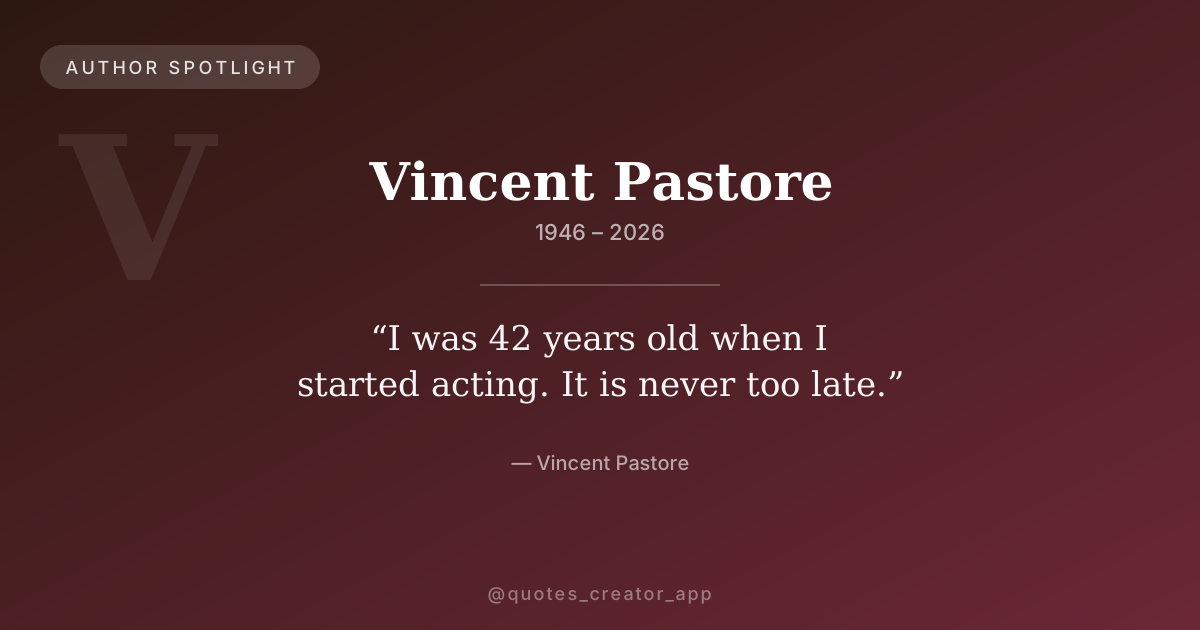
“I was running a nightclub in New Rochelle, driving a limo, doing whatever it took to pay the bills. The Dillon brothers kept telling me I should act. I was 42 years old. It is never too late to find the thing you were meant to do.”
The meaning behind these words
This is the foundational statement of Pastore’s entire life, and it carries a specific kind of courage that is rarely celebrated. We lionize the prodigies — the twenty-two-year-olds who take the world by storm, the child actors who grow up on screen. But Pastore represents something more difficult and, in many ways, more admirable: the decision to begin at an age when most people have stopped believing that beginnings are possible. Forty-two is not young. It is the middle of a life, the point at which careers are supposed to be established and trajectories set. Pastore looked at his life at forty-two — a man who had been a sailor, a club owner, a chauffeur — and decided that the thing he had not yet tried was still worth attempting. That takes a kind of faith in oneself that is deeper than ambition. It is the faith that the future is not yet written.
The final sentence — “It is never too late” — is the kind of cliché that most people dismiss, but Pastore earned the right to say it. He was not dispensing self-help platitudes from a stage. He was describing his actual life. When he walked onto the set of Goodfellas at forty-four years old for a wordless, fleeting cameo, he was already older than most of the actors who would go on to become stars. And yet, within a decade, he would be part of the most acclaimed television ensemble of all time. His story is a counterargument to every timeline we impose on ourselves, every deadline we imagine, every voice that says “it is too late for me now.” It is not. It never was.
“What I brought to Big Pussy was authenticity. I grew up in the Bronx. I knew those guys. I wasn’t playing a character — I was drawing from a life I had seen up close. Every gesture, every look, every silence — that was real.”
The meaning behind these words
Pastore is articulating something here that goes to the heart of the acting craft and, by extension, to something fundamental about how art gets made. The difference between imitation and embodiment is the difference between someone who has studied a world and someone who has lived in it. Pastore did not need to research how a mob soldier stands, talks, eats, or reacts to betrayal. He had spent his entire life in the neighborhoods where those men lived. The “authenticity” he describes is not a technique; it is a biography. This is why his portrayal of Big Pussy resonated so deeply with audiences and critics alike — because there was no membrane between the actor and the character. What viewers saw was not a performance. It was a translation.
This philosophy also illuminates why certain actors become iconic while others, however technically skilled, remain forgettable. Pastore’s career is a lesson in the power of specificity. He could not have played Hamlet. He did not need to. What he could do — and what he did better than almost anyone — was bring a complete, unvarnished, lived-in reality to the particular world he knew. In an industry that constantly urges actors to be versatile, to stretch, to transform, Pastore demonstrated that there is equal power in depth. Knowing one world completely, and being able to render it with total fidelity, is at least as valuable as being able to visit many worlds superficially. His career is not a testimony to range. It is a testimony to truth.
“I’ve played a lot of gangsters, but I’m not a tough guy. I’m a guy from the neighborhood who got lucky. The only thing I ever wanted was to do honest work and be respected for it.”
The meaning behind these words
There is an elegant humility in this statement that explains a great deal about why Pastore was so widely beloved, not merely as an actor but as a human being. He was, by all accounts, the opposite of the characters he played — gentle, warm, quick to laugh, generous with his time and money. He understood that the audience might conflate him with the mobsters he portrayed, and he took care to draw the distinction without dismissing the roles that made him famous. The phrase “a guy from the neighborhood who got lucky” is a beautiful piece of self-description because it accomplishes two things at once: it acknowledges his good fortune without minimizing his talent, and it roots his identity in the community that shaped him rather than in the fame that followed.
The final clause — about honest work and respect — reveals what actually drove him. Pastore was not motivated by celebrity, by wealth, or by the trappings of Hollywood. He was motivated by the same thing that motivates a good mechanic or a dedicated teacher: the desire to do the job well and be recognized for it by the people who matter. This is an old-fashioned value, the kind of thing that sounds almost quaint in an era of viral fame and algorithmic celebrity. But it is also the reason his career endured for nearly four decades while so many others flared and faded. When you are chasing respect rather than attention, the work itself becomes the reward, and the work, for Pastore, was always enough.
“When I initially committed to joining Dancing with the Stars, I didn’t realize just how physically demanding it would be for me. Unable to put forth my best effort, I felt it appropriate to step aside and give someone else the opportunity.”
The meaning behind these words
On its surface, this is a standard show-business withdrawal statement — polite, professional, and designed to avoid controversy. But read more closely, it reveals something essential about Pastore’s character. He does not blame the show, the producers, or the format. He does not claim injury or unfair treatment. He simply acknowledges, with quiet candor, that the challenge exceeded his capacity and that the fair thing to do was to make way for someone who could rise to it. This kind of self-awareness — the ability to recognize one’s own limits without shame or defensiveness — is vanishingly rare in any profession, and rarer still in an industry where ego and image management consume most of the available oxygen. Pastore stepped aside after one week, not because he had failed, but because he had been honest.
There is also a subtler lesson here about integrity. In a culture that valorizes persistence at all costs — the grind, the hustle, the refusal to quit — Pastore demonstrated that sometimes the most honorable thing a person can do is leave. He knew he could not give the audience or his professional partner what they deserved, and rather than stumble through the season as a novelty act, he chose to clear the stage. The decision cost him screen time and perhaps a degree of celebrity, but it preserved something more important: the sense that his work, whatever it was, would always be his best effort. If he could not deliver that, he would not deliver anything. That is not weakness. That is principle.
“When the doctor told me I had cancer, I didn’t feel sorry for myself. I thought about my daughter, my friends, the people who counted on me. You fight. That’s what you do. You don’t ask why — you get up and you fight.”
The meaning behind these words
This quote distills a philosophy of resilience that is simple to state and enormously difficult to practice. When Pastore was diagnosed with prostate cancer in 2014, he was sixty-eight years old — old enough to have considered retirement, old enough to feel that he had already lived a full life, old enough to be tempted by despair. Instead, he reacted the way he had reacted to every other obstacle in his life: by refusing to be the victim of his own story. The phrase “you don’t ask why” is particularly striking because it rejects the most natural human response to suffering — the demand for meaning, for explanation, for cosmic justice. Pastore suggests that the search for “why” is a trap, a detour that consumes energy better spent on the task of survival. This is not stoicism as an intellectual posture. It is stoicism as a survival strategy, earned through decades of real hardship.
The pivot away from self-pity and toward the people who depend on you is also revealing. Pastore does not frame his fight as an act of self-preservation. He frames it as an obligation to others — to his daughter, his friends, the community that had sustained him. This is consistent with the code he absorbed growing up in an Italian-American family in the Bronx: you endure not for yourself but for the people who need you. Suffering is not ennobling; love is. And the strongest motivation to survive is not the fear of death but the recognition that there are people whose lives would be diminished by your absence. Pastore survived his cancer, and for the remaining twelve years of his life, he continued to work, to laugh, to cook, to appear on podcasts and television shows, to be, in every sense, still here — still defiant, still grateful, still exactly himself.
Vincent Pastore’s legacy
Vincent Pastore’s legacy rests, inevitably and deservedly, on The Sopranos, the series that redefined television and elevated the mob drama into genuine literature. But to reduce him to a single role — however iconic — would be to misunderstand what made him matter. He was, in an industry that prizes youth and novelty above almost everything else, a living refutation of the idea that life’s best chapters must be written in your twenties. He began acting at an age when most people are preparing their midlife crises, and within a decade he had created a character so vivid that the mere mention of the name “Big Pussy” now calls forth, for millions of people, a complete and detailed emotional memory — the warmth, the humor, the tragedy, the boat, the water, the silence. That is not luck. That is the alchemy of a man who waited until he had something real to give before he stepped in front of a camera, and then gave all of it.
But his broader legacy is even more valuable because it is more replicable. Pastore demonstrated that a meaningful career does not require a blueprint. He did not go to an elite conservatory, did not get discovered at a Hollywood soda fountain, did not follow any of the prescribed paths. He lived a full, complicated, sometimes difficult life — the Navy, the nightclub, the limousine — and when he finally found his way to acting, he brought every bit of that life with him. The work was better because the man was fuller. For everyone who has ever worried that they have missed their window, that their real life is happening somewhere else, that they are too old or too late or too far behind, Vincent Pastore stands as an exhibit for the defense. You can start at forty-two. You can start at sixty. The only thing you cannot do is decide, prematurely, that the race is over when you have not yet taken a single step.
Create graphics with Vincent Pastore’s quotes
Vincent Pastore’s words carry a hard-won wisdom that makes them perfect for quote graphics. Whether you are looking for motivation to start something new, seeking a reminder that it’s never too late, or wanting to share the perspective of a man who lived fully and generously, Quotes Creator helps you transform these quotes into beautiful, shareable designs with custom fonts, gradients, and layouts.
Why we chose Vincent
Vincent Pastore was never supposed to be famous. He did not have the look, the training, the connections, or the timing. What he had was a face that told the truth, a lifetime of real experience, and the courage — at an age when most people have stopped believing in second acts — to try something new. His death this week has reminded the world of what a quiet force he was, not just on The Sopranos but in every room he entered. These five quotes trace the arc of a man who understood that authenticity is the only currency that doesn’t depreciate, that integrity is more durable than fame, and that the only thing you can never recover is the time you spend convincing yourself it is too late to begin.
— ThinkPeak Studio Editorial Team
Create your own quote graphic with this quote
Turn this line into a shareable graphic in seconds — free, no signup needed. For video quotes and 100+ templates, try the Android app.
Advertisement
Enjoyed this article? Get more like it in your inbox.