On this page
Author Spotlight: Wladimir Klitschko
He was the most dominant heavyweight of his generation and, by most honest reckonings, the most misunderstood. For a decade the critics complained that Wladimir Klitschko was boring — too cautious, too disciplined, too scientific — and then he retired, and the record books revealed the truth: no one in the long, brutal history of the heavyweight division had ever reigned as long as he did, or beaten as many challengers, or won so completely with so little damage taken. He was not boring; he was better. “You either win or lose in your mind,” he liked to say, and the sentence turned out to be the operating system of his entire life — a life that began in a Soviet military family evacuated from Chernobyl, reached its peak on a gold-medal podium in Atlanta and in a decade of title defenses across Europe, and has found its most serious chapter, in his fifties, on the side of a country fighting for its existence. This is the story of the thinking man’s heavyweight — the one they called Dr. Steelhammer.
Who is Wladimir Klitschko?
Wladimir Klitschko was born on 25 March 1976 in Semipalatinsk — now Semey — a city in the Kazakh Soviet Socialist Republic, into a family that embodied the contradictions of the late Soviet Union. His father, Volodymyr Rodionovych Klychko, was a major general in the Soviet Air Force and later a military attaché, a decorated officer whose career moved the family constantly across the empire. The brothers spent 1980 to 1985 in Czechoslovakia, where their father was stationed with the Central Group of Forces, and then, in the mid-1980s, the family lived in Pripyat, the city built to house the workers of the Chernobyl nuclear plant. When the reactor exploded in April 1986, the Klitschkos were among the tens of thousands evacuated, and their father — one of the officers tasked with commanding the cleanup of the disaster — was afterward diagnosed with the cancer that would eventually kill him. The younger of two sons — his brother Vitali, five years his senior, would himself become a world champion and, decades later, the mayor of Kyiv — Wladimir grew up a military child, changing schools so often that his brother became, by necessity, his closest friend and his fiercest rival. Both brothers would go on to earn PhDs in sports science, Wladimir’s dissertation examining how much training to give athletes between fourteen and nineteen — an intellectual pedigree so unusual in the fight game that it earned the younger Klitschko his enduring nickname: “Dr. Steelhammer.”
The boxing began almost as a family inheritance. Wladimir started training at the Brovary Olympic Reserve School in the late 1980s and later sharpened his craft in Poland’s Gwardia Warszawa club, where, as one Polish coach recalled, the Klitschko brothers “used to demolish our boys.” His amateur career was a long catalogue of near-total domination: a junior European championship in 1993, a junior world silver in 1994, and finally, in 1996, the prize that announced him to the world — a gold medal in the super-heavyweight division at the Atlanta Olympics, won against the Tongan Paea Wolfgramm in a tournament in which he also avenged his European-championship defeat to the Russian Alexei Lezin. He left the amateurs with a record of 134 wins and 6 losses, and turned professional later that year under the Hamburg-based Universum Box-Promotion. The early professional years taught him the sport’s cruelty. After running his record to 24-0, he met the journeyman Ross Puritty in 1998 and, fighting in Ukraine for the only time in his professional life, punched himself out against a man who refused to fall, losing by stoppage in the eleventh round. He rebuilt, won the WBO world title from Chris Byrd in 2000 in a fight billed as “Revenge of the Brother” — Byrd had taken the belt from Vitali — and then, in 2003 and 2004, suffered the two knockouts that nearly ended him: an upset stoppage loss to Corrie Sanders and another to Lamon Brewster, losses that had the boxing world writing his obituary.
What happened next is the reason he is remembered as far more than a cautionary tale. In 2004 Klitschko hired the legendary trainer Emanuel Steward, the man who had rebuilt Lennox Lewis, and began the transformation that would define the rest of his career — from an aggressive, vulnerable puncher into the most defensively disciplined heavyweight of his generation, a fighter who measured, jabbed, and patiently dismantled opponents behind a guard that was almost impossible to penetrate. The partnership lasted until Steward’s death in 2012 and produced one of the great second acts in boxing history. From 2006, when he regained the IBF title in a rematch with Byrd, through 2015, Klitschko collected and unified every meaningful belt in the division — the IBF, the WBO, the Ring magazine title, and finally the WBA in 2011 — and, together with Vitali, presided over the period now known as the “Klitschko Era,” a decade in which the brothers simply owned heavyweight boxing. The numbers are almost absurd: 4,382 days as world champion, the longest reign in heavyweight history; 23 opponents beaten in world-title fights, another all-time record; and an audience, by some estimates, of up to half a billion viewers worldwide for his biggest fights. His reign ended in 2015 with a loss to Tyson Fury, and his career ended in 2017 after a heroic, near-victorious effort against Anthony Joshua at the age of forty-one. In 2021 he was elected to the International Boxing Hall of Fame in his first year of eligibility.
The man who retired was never only a boxer. When Russia launched its full-scale invasion of Ukraine in February 2022, Klitschko — at forty-five — enlisted in the Ukrainian armed forces, and he has spent the years since as one of his country’s most visible and persuasive voices abroad, moving between the front and the lectern, raising funds, and framing the war for Western audiences with the same analytical clarity he once brought to a ring. It was a role he seemed to have been preparing for his whole life: the son of a Soviet general who became a Ukrainian patriot, the brother of the mayor of a city under siege, the PhD who always insisted that boxing was a contest of minds before it was a contest of fists. His private life has followed the same measured path — a long, on-and-off relationship with the actress Hayden Panettiere, with whom he has a daughter, Kaya — and his public utterances have grown only more weighty with time. He speaks four languages, reads voraciously, and has described his own approach to fighting in terms that sound more like epistemology than athletics. “You either win or lose in your mind,” he has said. It is the sentence that explains everything.
Wladimir Klitschko’s most memorable quotes
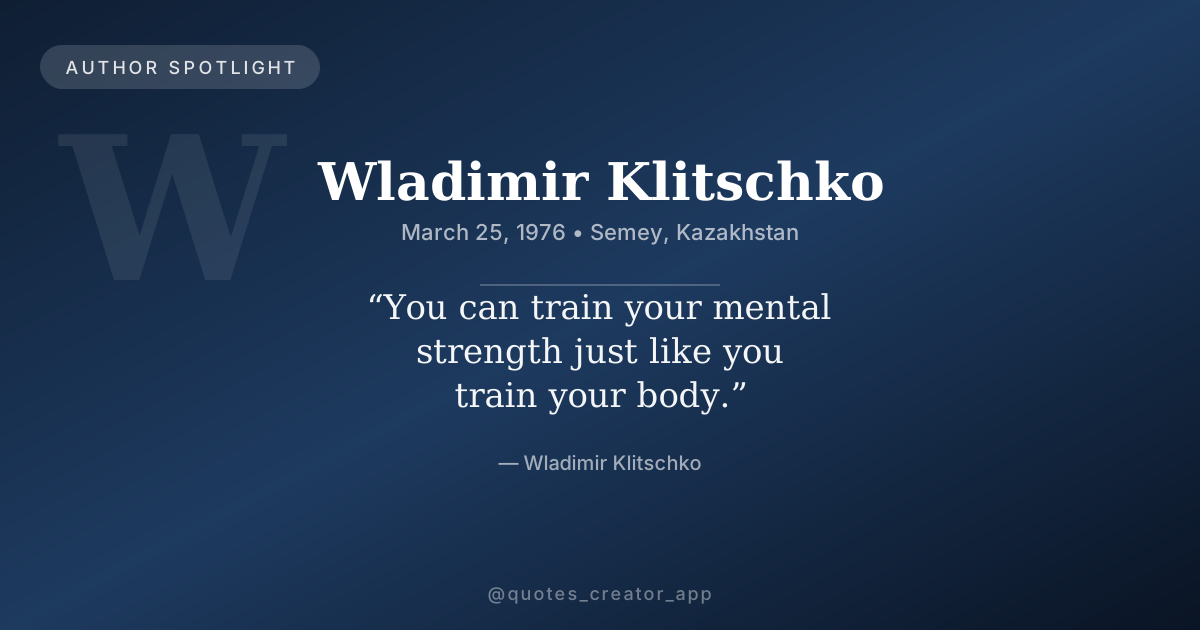
“Mental strength is really important because you either win or lose in your mind. And I’m not solely talking about sporting matches, boxing events — anything you do, you do it first with your mental strength. And you can actually train and develop it, and I am responsible for what I’m saying because I have experience with that.”
The meaning behind these words
This is the thesis of Klitschko’s entire philosophy, and it is remarkable for how deliberately he builds it. The opening claim — “you either win or lose in your mind” — is the kind of thing that sounds like a platitude until you remember who is saying it and what it cost him to learn. He is a man who was knocked out twice, in humiliating fashion, when the boxing world had already crowned him, and who responded not by fighting harder but by thinking harder — by re-engineering his entire approach around the discipline he had earned writing a doctoral dissertation. When he says that mental strength is trainable, he is speaking as a scientist, not a motivational speaker: the word “train” is doing the essential work, the insistence that the mind is not something you are born with but something you build, muscle by invisible muscle. This is what separates his version of toughness from the macho posturing of the fight game. Toughness, for Klitschko, is not a fixed trait you either possess or lack. It is a skill.
And then there is the final clause, which is the whole point and the most quietly forceful thing he ever said: “I am responsible for what I’m saying because I have experience with that.” Most athletes talk about the mind because it sounds good in an interview. Klitschko talks about it because he has lived the difference it makes — the difference between the frightened, arm-weary young man who was stopped by Sanders and Brewster and the patient, remorseless champion who spent the next decade beating everyone put in front of him. The sentence is a claim of authority grounded not in talent but in evidence. He is not selling confidence; he is reporting the results of an experiment he ran on himself. And the experiment worked so well that the numbers now function as proof: the longest reign in heavyweight history was built less on the left hook than on the conviction, held for 4,382 consecutive days, that the fight had already been decided before the bell rang.
“The first thing I learned in boxing is to not get hit. That’s the art of boxing. Execute your opponent without getting hit.”
The meaning behind these words
It is the most counterintuitive sentence in the sport, and it is the exact thing the critics never understood about Klitschko. Boxing, to the casual fan, is about aggression — about hitting, about hurting, about the drama of two men standing in a phone booth and trading damage until one of them falls. Klitschko spent his career rejecting that premise. “The first thing I learned in boxing is to not get hit,” he said, and the verb he reaches for to describe victory is not “destroy” or “knock out” but “execute” — cold, technical, almost bureaucratic. The art of boxing, in his telling, is not the art of violence but the art of avoidance, the discipline of winning while remaining untouched. This is why he was called boring, and it is precisely why he was unbeatable for a decade. He had inverted the sport’s central assumption: that a great fighter is someone who can absorb punishment. Klitschko believed a great fighter is someone who never has to.
The deeper meaning is about how to spend yourself in a fight — and, by extension, in a life. The man who takes punches is spending his body, round by round, buying a victory that will cost him more than it is worth; the man who refuses to get hit is playing a longer game, one measured in years and decades rather than rounds. There is a direct line from this sentence to Klitschko’s longevity, to the fact that he was still fighting — and nearly winning — world-title fights at forty-one, when most heavyweights have long since been reduced to slurred speech and shuffled feet. His style was not timidity; it was the most disciplined form of ambition, the refusal to confuse getting hurt with getting the job done. And there is a life lesson buried in it too, one he would carry far beyond the ring: that the goal is not to win the fight but to survive it intact, to be effective without being damaged, to execute the plan and walk away whole.
“After Chernobyl, thousands and thousands of people, if not millions, were given a death penalty and had to pay the price, our father among them.”
The meaning behind these words
The sentence does something remarkable with grammar: it takes the most terrible industrial disaster in human history and speaks of it in the cold, passive language of bureaucracy. “Were given a death penalty” — no subject, no villain, no one to blame, just a sentence handed down by an unseen authority and carried out across decades. There is a fury in the flatness of it, the fury of a man who has spent his life living inside the aftermath of a catastrophe that was, at every stage, someone’s choice and no one’s admission. And then, in the final three words, the abstraction collapses into the personal: “our father among them.” The millions become a single man. The statistic becomes a grief. Klitschko’s father commanded part of the Chernobyl cleanup and died of the cancer it gave him, and this sentence is the closest his son ever came, in public, to naming the cost of that duty. It is the reason there is always a certain gravity beneath Klitschko’s optimism — the reason a man this disciplined and this successful never quite sounds like a man who believes the world is fair.
But the quote also reveals why Klitschko never let Chernobyl become merely a private tragedy. He has spoken about the disaster his entire adult life, not as a victim but as a witness — and always with an insistence that radiation, in his words, “doesn’t recognize borders,” that what happened in Ukraine in 1986 is a warning to the whole world about what happens when safety is treated as a cost rather than a duty. This is the thread that connects the child evacuated from Pripyat to the forty-five-year-old man who enlisted to defend Ukraine in 2022. He learned, before he could read, that catastrophe is real, that it is human-made, and that the people who pay for it are almost never the people who caused it. That knowledge gave him a seriousness the fight game rarely produces. It is also, in some sense, what he has been fighting against his entire life: the idea that a human being is just a number in a ledger, a body to be spent, a cost to be absorbed.
“Politics is comparable to boxing. The only thing is that in politics there are basically no rules. In boxing, you can get a black eye, but in politics you can get poison in your food or a bullet in the head. It’s definitely rougher and tougher than other sports.”
The meaning behind these words
For a man who spent his career insisting that boxing was a clean, disciplined, almost scientific pursuit, this quote is a startling concession — and it is the concession that gives the comparison its weight. He is not saying politics is like boxing; he is saying politics is boxing with the rules removed, boxing taken to its most brutal and least honest conclusion. The escalation is carefully staged, and it moves from the acceptable to the unthinkable in a single breath: in boxing, the worst that happens is a black eye; in politics, the worst that happens is poison in your food or a bullet in your head. Coming from a man whose brother traded a heavyweight championship for the mayor’s office in Kyiv, the sentence is not an abstraction. It is a son’s and a brother’s assessment of the danger his own family has chosen to live inside. Klitschko knew, when he said this, exactly what politics could do to a man. He knew it before the rest of the world did.
And yet the quote is not cynical — or not only cynical. It is, in a strange way, the clearest statement of why he could not stay retired when the war came. Boxing, by his own account, was the safe arena, the one with rules and referees and a bell that ends everything. Politics — and the war that is its most violent expression — is the arena without any of those protections, which is precisely why it is the one that matters more. The man who built a career on the principle that you should never take a punch he could avoid walked, at forty-five, into the only fight that cannot be won on points and cannot be walked away from. The quote explains that choice better than any of the speeches he has given since. He had spent a lifetime mastering the rules of one brutal game, and then, when his country was attacked, he volunteered for a far more brutal one — because some fights are worth taking the poison and the bullet for, and because a man who understands the cost of a thing and steps into it anyway is not a fool. He is a patriot.
Wladimir Klitschko’s legacy
The measurable legacy is the easiest to state and, in its way, the least interesting. Wladimir Klitschko held the world heavyweight championship for 4,382 days — nearly twelve years — the longest reign in the history of the division, ahead of Joe Louis and every legend the sport has produced. He beat 23 different opponents in world-title fights, more than anyone before or since, defended a unified title a record number of times, and was elected to the International Boxing Hall of Fame in his first year of eligibility. The Olympic gold medal, the 53 knockouts, the hundreds of millions who watched him fight — all of it is in the record books, and none of it quite captures what made him significant. What Klitschko really did was change the definition of what a heavyweight champion could be. In a division historically dominated by fury and excess and early ruin, he was the champion who read books, spoke four languages, held a doctorate, and treated his body and his mind with the same methodical care. He made intelligence the centerpiece of a sport that had spent a century distrusting it.
The deeper legacy is the example, and it has two halves. The first is athletic: Klitschko proved, as thoroughly as anyone ever has, that a second act is possible after a humiliating defeat — that being knocked out is not the end of a career but, handled correctly, the beginning of a better one. The frightened young man stopped by Sanders and Brewster became the most dominant heavyweight of his era not by becoming more aggressive but by becoming more disciplined, and that transformation is now a permanent part of boxing’s instruction manual. The second half is harder to weigh but likely to outlast everything else. In the years since Russia invaded Ukraine, Klitschko has become something rarer than a former champion — a moral figure, a soldier-statesman who put his own body back into harm’s way for his country at an age when most retired athletes are settling into comfortable irrelevance. He and Vitali, the two brothers who once owned the heavyweight division, now stand together as symbols of a nation’s refusal to break. It is a strange and moving second act for a sport whose champions so often end their lives diminished and forgotten.
And there is, finally, the legacy of the idea he spent his whole life insisting upon — that the most important strength is the kind you cannot see. “You either win or lose in your mind,” he said, and the sentence, which once sounded like a boxer’s bromide, has turned out to be the operating principle of everything he has done since. The discipline that carried him through 134 amateur fights and 69 professional ones is the same discipline that now carries him through the grinding, unglamorous work of wartime — the fundraising, the diplomacy, the endless repetition of a simple message to a world that keeps looking away. He did not become a champion because he hit the hardest; he became a champion because he refused, for 4,382 days, to let himself be beaten before he stepped into the ring. And he has not become a symbol of Ukrainian resistance because he is fearless; he has become one because he understands that courage, like mental strength, is not something you are born with. It is something you train — one day, one decision, one fight at a time.
Create graphics with Wladimir Klitschko’s quotes
Klitschko’s words carry the same quality that made him a champion — they are measured, precise, and built to endure. Whether you need a line about training the mind, about winning without being damaged, or about the courage it takes to step into a fight with no rules, Quotes Creator helps you turn these quotes into beautiful, shareable designs with custom fonts, gradients, and layouts.
Why we chose Wladimir Klitschko
Wladimir Klitschko enters this spotlight at a moment when the world has, once again, turned its attention to him. In August 2026, his Wikipedia pageviews surged into the hundreds of thousands — a reminder that the former heavyweight champion has become, in his fifties, a figure of abiding public interest, standing at the intersection of sport and war as both a Hall of Fame athlete and a soldier in the defense of his country. But the timing, as it always is with these spotlights, is secondary to the substance. We chose Klitschko because his life is one of the rare ones that works as both a story and a lesson. He was the boxer who redefined what a heavyweight could be — the doctorate, the four languages, the discipline, the decade of dominance — and then, when his country was invaded, the champion who proved that the qualities that made him great in the ring were the same qualities his nation needed at its darkest hour.
The four quotes we have selected trace the spine of that story. They begin with his signature belief — that you win or lose in your mind, and that mental strength is a skill you can train — the sentence that turned out to be the operating system of his entire career. They move through his counterintuitive definition of boxing as the art of not getting hit, the philosophy of discipline that made his reign possible. They reach his quiet reckoning with Chernobyl, the disaster that shaped his childhood and killed his father, and the source of the gravity beneath everything he says. And they end with his chilling comparison of politics to boxing — the fight with no rules — the sentence that, read in hindsight, explains exactly why he enlisted to defend Ukraine. These are not the tidy maxims of a comfortable life. They are the words of a man who has been knocked down in front of the world, climbed back to the very top of his sport, and then, at forty-five, walked willingly into a fight far more dangerous than any he ever faced in the ring — and who has met it with the same thing he always relied on: not fury, but discipline, and not muscle, but mind.
— ThinkPeak Studio Editorial Team
Create your own quote graphic with this quote
Turn this line into a shareable graphic in seconds — free, no signup needed. For video quotes and 100+ templates, try the Android app.
Advertisement
Enjoyed this article? Get more like it in your inbox.