On this page
Author Spotlight: Zendaya
Emmy-winning actress, singer, and one of the most influential voices of her generation.
Who is Zendaya?
Zendaya Maree Stoermer Coleman was born on September 1, 1996, in Oakland, California, into a family where the arts were not a distant dream but a daily reality. Her mother, Claire Stoermer, worked as the house manager at the California Shakespeare Theater in Oakland, and it was there, among the costumes and the stage lights, that a young Zendaya first discovered the transformative power of performance. Her father, Kazembe Ajamu Coleman, is African American with roots in Arkansas, while her mother has German and Scottish ancestry — a mixed heritage that would later inform her nuanced perspective on identity and representation. Her name itself is a gift: derived from the Shona word tendai, it means “to give thanks.” Growing up as one of six children, Zendaya spent her formative years at CalShakes, absorbing Shakespeare, helping backstage, and eventually stepping onto the stage herself in productions like Richard III and Twelfth Night.
Her professional journey began modestly — as a child model for Macy’s and Old Navy, and as a backup dancer who appeared in commercials and music videos. But it was in 2010, at just 14 years old, that she landed the role of Rocky Blue on the Disney Channel’s Shake It Up, a sitcom about teenage dancers that made her a household name among a generation of young viewers. She followed this with K.C. Undercover (2015–2018), where she not only starred but also served as a co-producer — an early sign of the creative control she would fight for throughout her career. The Disney years gave her fame, but Zendaya was never content to stay in one lane. In 2019, she took the role that would redefine her career and the cultural conversation around her: Rue Bennett, a teenager battling addiction, in HBO’s raw and unflinching drama Euphoria. Her performance was devastating, raw, and utterly transformative, earning her the Primetime Emmy Award for Outstanding Lead Actress in a Drama Series in 2020 — making her, at 24, the youngest winner ever in the category. She won it again in 2022, cementing her status as one of the most formidable actors of her generation.
What sets Zendaya apart is not just her talent but her unwavering commitment to authenticity. In an industry that often demands conformity and in an era of social media that rewards performance, she has made “keeping it real” her guiding principle. She speaks openly about her anxieties, her creative struggles, and the pressure of being held up as a role model. She has used her platform to advocate for representation in Hollywood, to challenge narrow beauty standards, and to remind young people of color that their hair, their skin, and their stories are more than enough. Her fashion choices — whether wearing faux locs on the Oscars red carpet or a custom haute couture gown at the Met Gala — are never just about aesthetics. They are statements about identity, history, and the right to take up space. For Zendaya, every public appearance is an opportunity to show the world that you can be glamorous, vulnerable, powerful, and real all at the same time.
Her film career has mirrored her television ascent. She joined the Marvel Cinematic Universe as MJ in Spider-Man: Homecoming (2017) and its sequels, bringing dry wit and emotional depth to a franchise typically defined by spectacle. She held her own opposite Timothée Chalamet in Denis Villeneuve’s Dune films, starred in the stripped-down relationship drama Malcolm & Marie (2021) which she also co-produced, demonstrated comedic and athletic range in Luca Guadagnino’s Challengers (2024), and most recently joined Christopher Nolan’s ensemble for The Odyssey (2026). Each role has been a deliberate step — never repeating herself, always seeking a new challenge. Today, at 29, Zendaya stands at a rare intersection of critical acclaim, commercial success, and cultural influence. She is proof that you do not have to be loud to be powerful, and that the truest form of stardom is simply being yourself.
Zendaya’s most memorable quotes
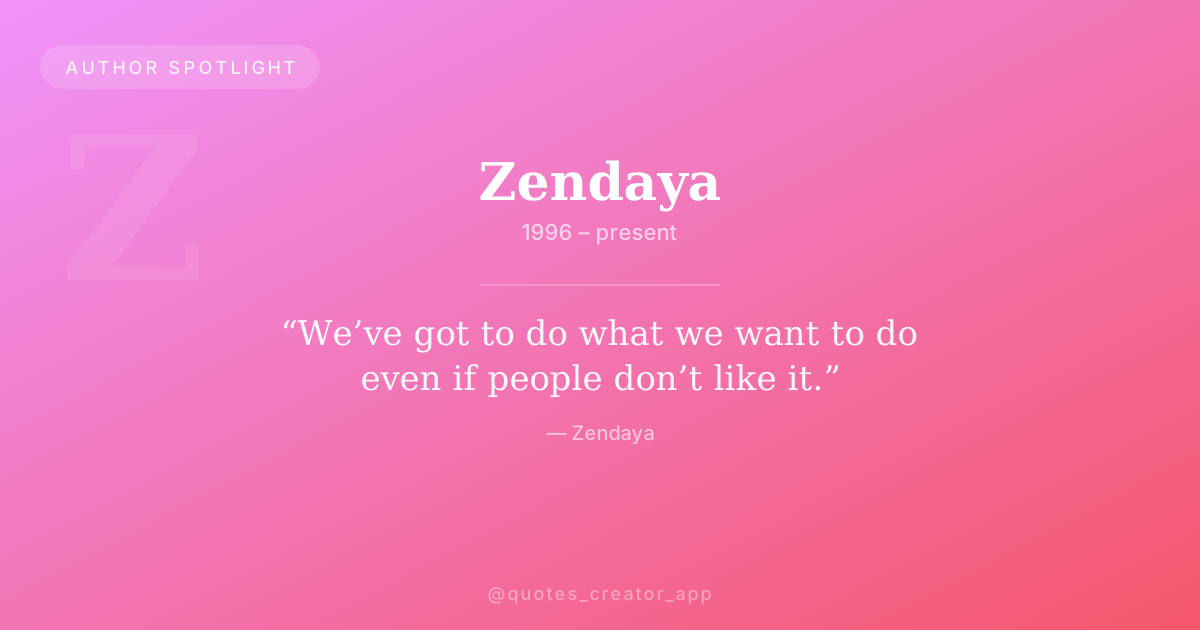
“I think we can’t allow ourselves to get caught up in other people’s opinions of ourselves because then we’re never going to progress, we’re never going to go forward. So we’ve got to be real. We’ve got to do what we want to do even if people don’t like it. The greatest of the greats wouldn’t be the greatest of the greats if they didn’t try stuff.”
The meaning behind these words
This quote captures Zendaya’s philosophy in its purest form: that growth is impossible when you are perpetually looking over your shoulder for approval. She delivered these words at a pivotal moment in her career, as she was transitioning from Disney Channel stardom to the kind of serious, adult roles that would eventually earn her two Emmys. The choice to experiment with bold hairstyles — including a mullet that drew online mockery — was not a fashion misstep but a deliberate act of creative freedom. She understood that the greats in any field are defined not by their caution but by their willingness to try things that might not work.
What makes this philosophy so resonant, especially for her younger audience, is that it rejects the curated perfectionism of social media culture. In a world where every post is filtered and every image is managed, Zendaya’s insistence on being “real” is quietly revolutionary. She is not arguing for carelessness — she is arguing that authenticity is a form of courage, and that the fear of judgment should never be the thing that stops you from evolving.
“There is already harsh criticism of African American hair in society without the help of ignorant people who choose to judge others based on the curl of their hair. My wearing my hair in locs on an Oscar red carpet was to showcase them in a positive light, to remind people of color that our hair is good enough. To me locs are a symbol of beauty and strength, almost like a lion’s mane.”
The meaning behind these words
In 2015, Zendaya walked the Oscars red carpet wearing her hair in faux locs. On Fashion Police, Giuliana Rancic commented that the hairstyle made her look like she “smells like patchouli oil or weed.” The remark was widely condemned as racist, and Zendaya’s response — a lengthy, thoughtful, and composed statement posted to social media — became a defining moment in her public life. She was 18 years old, already navigating an industry that had spent decades marginalizing Black hair, and she chose to respond not with anger but with education.
Her framing of locs as “a symbol of beauty and strength, almost like a lion’s mane” is particularly powerful because it reclaims a narrative. For centuries, Black hair has been policed, mocked, and stigmatized in Western culture — deemed “unprofessional,” “unkempt,” or “political.” By wearing locs on one of the most-watched red carpets in the world and then defending that choice with poetry and precision, Zendaya turned a moment of insult into a moment of cultural education. She was telling millions of young Black viewers that their hair was not something to be apologized for or straightened away — it was a crown.
“You can go about it as cultural appreciation or cultural appropriation. You have to be very careful. Some things are really sacred and important to other cultures, so you have to be aware, politically, about those things before you just adopt them.”
The meaning behind these words
Long before conversations about cultural appropriation became mainstream, Zendaya was articulating the distinction with clarity and nuance. This quote reflects a maturity far beyond her years at the time. She was not simply repeating a buzzword; she was making a distinction that many adults in the public eye still struggle with: the line between appreciating another culture and taking from it without understanding. For Zendaya, the difference lies in awareness — understanding the sacredness of certain cultural symbols and traditions, and recognizing that adopting them without that understanding can cause real harm.
This perspective is deeply informed by her own mixed-race identity. As a Black woman in Hollywood who has navigated spaces where she is both celebrated and scrutinized, she understands that cultural symbols carry weight. Her emphasis on being “politically aware” is a call to thoughtfulness, not a lecture — an invitation to engage with the world’s cultures with respect rather than entitlement. In a celebrity culture that often rewards ignorance, Zendaya’s insistence on cultural literacy sets her apart as a genuinely thoughtful public figure.
“I think it’s a responsibility, but like Tupac Shakur, I’m a real model. Which means: I’m not pretending to be something that I’m not, because like he said, people are going to be disappointed when they find out who you are, because it’s not going to be what you presented to the world. So just keep it real.”
The meaning behind these words
Zendaya was 19 when she articulated this distinction between a “role model” and a “real model,” and in doing so, she reframed what public responsibility looks like for a generation raised on curated Instagram feeds and performative authenticity. The conventional idea of a role model often involves projecting an image of perfection — no mistakes, no rough edges, no contradictions. Zendaya, following Tupac’s lead, rejects that entirely. Her responsibility, as she sees it, is not to be flawless but to be honest — to show young people that you can be successful without pretending to be something you are not.
This philosophy has guided her career choices and public presence ever since. She does not pretend her life is free of anxiety or self-doubt. She does not curate a pristine image. She allows herself to be seen in moments of vulnerability — crying in interviews, admitting to imposter syndrome, acknowledging that fame is strange and disorienting. And in doing so, she gives her audience something far more valuable than a polished role model: she gives them permission to be human.
Zendaya’s legacy
Zendaya’s legacy is still being written, but its outlines are already remarkably clear. She has become the definitive example of what a Disney Channel graduate can achieve when talent meets intentionality. Where the path from child stardom to serious acting was once littered with cautionary tales, Zendaya navigated it with an almost preternatural sense of purpose — choosing roles that challenged her, producers who respected her, and projects that aligned with her values. Her two Emmy wins for Euphoria shattered records and expectations, but they also opened doors for other young actors of color who had been told that the transition from teen idol to dramatic lead was insurmountable.
Beyond awards and box office numbers, her most enduring impact may be cultural. She has helped reshape the conversation around beauty standards, proving that Black hair in all its forms belongs on red carpets, magazine covers, and movie screens. She has modeled a kind of fame that does not require her to sacrifice privacy, personality, or principles. And in an era where young people are bombarded with images of artificial perfection, she has offered a clear and consistent counter-message: the most powerful thing you can be is yourself. As she moves into the next phase of her career — producing, directing, and continuing to choose projects that defy easy categorization — the throughline remains unmistakable. Zendaya is not just building a résumé; she is building a blueprint.
Create graphics with Zendaya’s quotes
Zendaya’s words have a timeless quality that makes them perfect for quote graphics. Whether you are sharing on Instagram, creating a vision board, or looking for daily inspiration, Quotes Creator helps you transform these quotes into beautiful, shareable designs with custom fonts, gradients, and layouts.
Why we chose Zendaya
Zendaya represents something rare in modern celebrity: a genuine alignment between the person and the persona. Her quotes are not polished PR soundbites — they are windows into a mind that has been thinking seriously about identity, representation, and authenticity since she was a teenager. As she stars in Christopher Nolan’s The Odyssey and continues to expand her creative footprint, the moment felt right to look back at the words that have defined her journey so far. She is, in the truest sense, an author of her own story — and it is one we are honored to spotlight.
— ThinkPeak Studio Editorial Team
Create your own quote graphic with this quote
Turn this line into a shareable graphic in seconds — free, no signup needed. For video quotes and 100+ templates, try the Android app.
Advertisement
Enjoyed this article? Get more like it in your inbox.