On this page
Author Spotlight: Zlatan Ibrahimovik
From a boy kicking a ball through the concrete streets of Rosengård to becoming one of the most decorated footballers in history — a look at the man who treated the pitch as a stage and his career as a work of art.
Who is Zlatan Ibrahimovik?
Zlatan Ibrahimovik was born on October 3, 1981, in Malmö, Sweden, to a Bosnian father and a Croatian mother. He grew up in the gritty Rosengård district, a working-class immigrant neighborhood where football was the common language and survival was the daily curriculum. His parents divorced when he was young, and he shuttled between their homes, often finding his only stability on the pitch. Football was not just a pastime — it was his escape, his identity, and the one place where his fierce, unapologetic confidence made perfect sense. By the time he was a teenager, his talent was impossible to ignore, and at seventeen he made his professional debut for Malmö FF, the local club he had supported as a boy.
From Malmö, Ibrahimovik’s trajectory was meteoric. He signed with Ajax in 2001, where his outrageous skills — including a now-legendary solo run against NAC Breda — marked him as European football’s next great striker. He moved to Juventus, then to Inter Milan, where he won three consecutive Serie A titles and became the focal point of one of Italy’s most dominant teams. A then-world-record transfer to Barcelona followed; though his single season there was stormy, it added a La Liga title to his collection. He returned to Italy with AC Milan, won another scudetto, then moved to Paris Saint-Germain, where he became the club’s all-time leading scorer and won four Ligue 1 titles. Brief stops at Manchester United (Europa League, EFL Cup) and LA Galaxy preceded a triumphant return to AC Milan at age thirty-eight — where he promptly won his fifth Serie A title. In total, he won 34 trophies across seven clubs in four countries, scored more than 570 career goals, and saved some of his most spectacular strikes for the biggest stages.
What set Ibrahimovik apart was not just his talent but the unshakable self-belief that defined him. He spoke about himself in the third person not merely out of ego but because he had constructed a character — “Zlatan” — that was larger than the boy from Rosengård. This character was a psychological armor: a way of insisting on his worth in a sport that had often dismissed players from immigrant backgrounds. His career was a masterclass in the power of audacity. He turned down Arsenal as a teenager because he wanted first-team football, not a trial. He left Barcelona because he refused to be a supporting actor. He returned to a fading AC Milan at thirty-eight and made them champions again. His entire philosophy can be summed up in his own words: “Everything is in your head. Whatever you want to do, you will do it.”
Ibrahimovik retired in June 2023 at age forty-one, one of the oldest players ever to compete at the highest level of European football. His legacy is double-edged: on one side, the cold statistics of a world-class striker; on the other, the intoxicating, impossible-to-quantify force of his personality. He made football fun for a generation, not just by scoring wondergoals but by treating the game as a stage for self-expression. His 35-yard bicycle kick against England in 2012 is widely considered one of the greatest goals ever scored. Off the pitch, he has worked as a UNICEF ambassador, released two autobiographies, and launched his own fashion and fragrance lines. But his most enduring contribution may be the example he set for young people from difficult backgrounds: that the circumstances of your birth do not determine the scope of your ambition.
Zlatan Ibrahimovik’s most memorable quotes
“Zlatan doesn’t do auditions.”
The meaning behind these words
This is perhaps the most famous line of the Ibrahimovik mythology. As a seventeen-year-old at Malmö, he was invited to trial with Arsenal by manager Arsène Wenger. Most teenage footballers from a small Swedish club would have jumped at the chance. Ibrahimovik turned it down. He later explained that he did not do auditions — you either believed in him or you did not. The line is breathtaking in its confidence, but it was not mere arrogance: it reflected a deep understanding of his own value. He knew that a trial was not a test of talent but a test of hierarchy, and he refused to submit to it. The quote has since become a shorthand for refusing to prove yourself on terms that diminish who you are.
The deeper wisdom here is about knowing when to walk away. Ibrahimovik’s career is full of moments where he chose himself over security, over comfort, over the approval of people in power. He did not take the safe path; he took the path that respected his own sense of worth. For anyone negotiating a career, a relationship, or a creative project, the lesson is resonant: sometimes the most powerful move is to say no — not because you are afraid, but because you know your value and refuse to let anyone else define it.
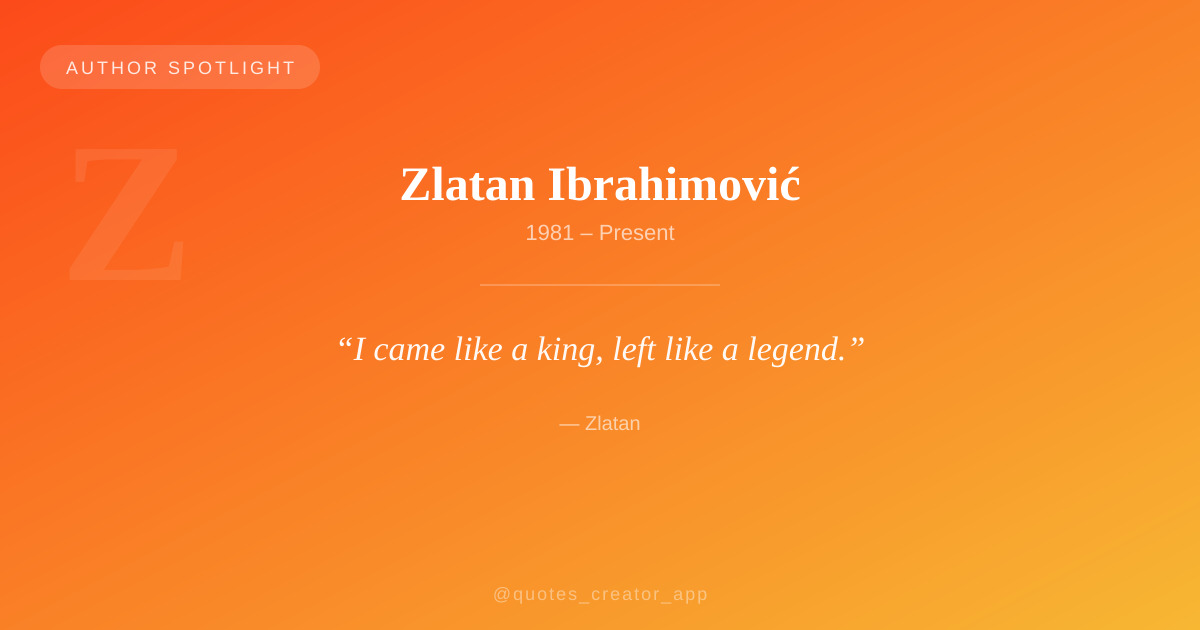
“I came like a king, left like a legend.”
The meaning behind these words
Ibrahimovik delivered this line before his final match at the Parc des Princes, the stadium he had called home for four years while playing for Paris Saint-Germain. It is a perfect self-written epitaph, combining regal entrance with mythological exit. The line captures something essential about how Ibrahimovik understood his own career: as a narrative, a story with a beginning, middle, and end, each chapter marked by maximum impact. He did not simply play for PSG; he arrived as a conquering hero and departed as an immortal. The arrogance is unmistakable, but it is earned — he had made PSG the dominant force in French football, scored 156 goals in 180 appearances, and transformed the club’s entire identity.
But the quote also speaks to a broader truth about how we choose to leave things — jobs, relationships, cities, eras. There is dignity in a well-timed exit, in knowing when your chapter is complete. Ibrahimovik understood that leaving at the right moment is as important as arriving at the right one. His entire career was a series of perfectly timed moves, each departure adding to the legend rather than diminishing it. The line reminds us that how you leave is part of what people remember, and that a great exit is as memorable as a great entrance.
“When you buy me, you are buying a Ferrari.”
The meaning behind these words
Ibrahimovik said this during his time at Paris Saint-Germain, comparing himself to one of the world’s most coveted automobiles. On the surface, it is pure bravado — a footballer comparing himself to a luxury sports car. But beneath the swagger is a sophisticated understanding of labor, value, and self-marketing. Ibrahimovik was not just saying he was expensive; he was saying he was elite, precise, and built for performance. A Ferrari is not a commuter car; it demands special treatment, premium fuel, and a driver who knows what they are doing. The metaphor implies that signing him is not a cost but an investment in guaranteed excellence.
The quote resonates because it reframes the conversation from price to value. In a world that often asks us to justify our worth, Ibrahimovik simply stated it as fact. He did not argue that he was worth the money; he declared it, and then spent two decades proving it. The lesson is a powerful one for professionals in any field: if you provide extraordinary value, you are entitled to extraordinary recognition. The trick is not to ask for it, but to make yourself undeniable. Ibrahimovik made himself undeniable, and then let the metaphor do the rest.
“I’m number one. I really feel that way. If you think you are the second it’s the end.”
The meaning behind these words
This quote gets to the core of what drove Ibrahimovik through two decades at the highest level of sport. It is not merely a statement of superiority — it is a philosophy of competition. For Ibrahimovik, believing you are the best is not optional; it is the foundational requirement of excellence. He says “if you think you are the second, it’s the end” — meaning that the moment you accept second place in your own mind, you have already lost. The battle is not just against opponents; it is against the part of yourself that would settle for less. This worldview is uncompromising, even ruthless, but it explains how Ibrahimovik remained at the elite level into his forties.
While other players declined with age, he adapted his game, reinvented his body, and never accepted diminished expectations. The psychological discipline required to maintain that belief through injuries, transfers, and the inevitable encroachment of younger talent is extraordinary. The quote is a window into the mindset of someone who refused to let the aging curve or anyone else’s opinion define his limits. It is a reminder that the first and most important competition is the one you have with yourself, and that the external scoreboard is meaningless if you have already conceded defeat internally.
“What Carew does with a football, I can do with an orange.”
The meaning behind these words
This line was Ibrahimovik’s response to criticism from Norwegian striker John Carew, who had dismissed his trickery on the pitch as unnecessary showboating. The genius of the reply is that it does not defend showboating — it escalates it to the level of absurd mastery. The implication is devastating: what Carew considers impressive, Ibrahimovik can do with a piece of fruit. The quote is a masterclass in rhetorical counterpunch, using humor to simultaneously dismiss the critic and magnify his own ability. It is a reminder that the most effective defense is often not a denial but an escalation.
But there is also a serious point beneath the wit about the difference between competence and mastery. Anyone can learn to control a football with hard work. To control an orange — to perform the same skills with a smaller, lighter, rounder object that bounces unpredictably — that is the difference between a professional and an artist. Ibrahimovik was not a footballer who happened to be skilled; he was a performer who happened to play football. The game was his canvas, and the orange was his brush. The quote reminds us that true mastery transcends the boundaries of its medium, and that the best practitioners make the impossible look effortless — and then make it look like a joke.
Zlatan’s legacy
When Zlatan Ibrahimovik walked off the pitch for the final time in June 2023, he left behind a career that defies easy summary. The 34 trophies speak to his success. The 570-plus goals speak to his brilliance. But the quotes — dozens of them, each more audacious than the last — speak to something rarer: a personality so large that it became inseparable from the talent. In an era of increasingly sanitized, media-trained athletes, Ibrahimovik was a throwback to an older tradition of sporting flamboyance. He was Muhammad Ali with a football, confident not because he had calculated the odds but because he had refused to calculate them. He understood that sport is entertainment, and that entertainment demands character.
His legacy is already visible in the generation of young players who cite him as an influence — not just for his technique but for his fearlessness. At a time when football is increasingly systematized and tactical, Ibrahimovik proved that individuality still matters. The bicycle kick against England, the chip against Italy, the no-look passes, the backheel goals — these are not just highlights; they are statements of intent. They say: I am here to astonish you. In a world that often rewards caution over creativity, Ibrahimovik chose audacity every time. That choice, repeated across twenty-four years, is his most enduring gift to the sport.
Create graphics with Zlatan’s quotes
Zlatan Ibrahimovik’s words have a timeless quality that makes them perfect for quote graphics. Whether you are sharing on Instagram, creating a vision board, or looking for daily inspiration, Quotes Creator helps you transform these quotes into beautiful, shareable designs with custom fonts, gradients, and layouts.
Why we chose Zlatan
We are publishing this spotlight in July 2026, as the FIFA World Cup has captivated the globe and football conversations dominate everywhere. Ibrahimovik, though retired, remains a towering presence — his highlights still circulate, his quotes still recited, his shadow still falling over every striker who promises to be different. In a tournament season that celebrates collective achievement, we wanted to spotlight a player who proved that individual brilliance and team success are not opposites. Zlatan Ibrahimovik was a team player who never stopped being an individual, and that paradox — the king who also served, the legend who also sweated — is what makes his story worth telling.
— ThinkPeak Studio Editorial Team
Create your own quote graphic with this quote
Turn this line into a shareable graphic in seconds — free, no signup needed. For video quotes and 100+ templates, try the Android app.
Advertisement
Enjoyed this article? Get more like it in your inbox.