Quote of the Day: John Tuggle on Saying Goodbye with Gratitude
He was selected with the very last pick of the 1983 NFL Draft — a label that comes with the ceremonial title “Mr. Irrelevant” — and he became the first final pick in league history to make his team’s roster. He was the New York Giants’ special teams player of the year, he was diagnosed with cancer the next summer, and he died at 25, two years later. This week he is one of the most-read people on the internet again: the trailer for the biopic Mr. Irrelevant: The John Tuggle Story sent his Wikipedia page past 334,000 views in a single day. And in that surge of attention, the moment everyone keeps landing on is the last time his coach ever saw him — when Tuggle showed up in a black suit with a bottle of champagne and spoke the line that has become his legacy: I don’t think I’m going to be seeing you. I just want to thank you for everything.
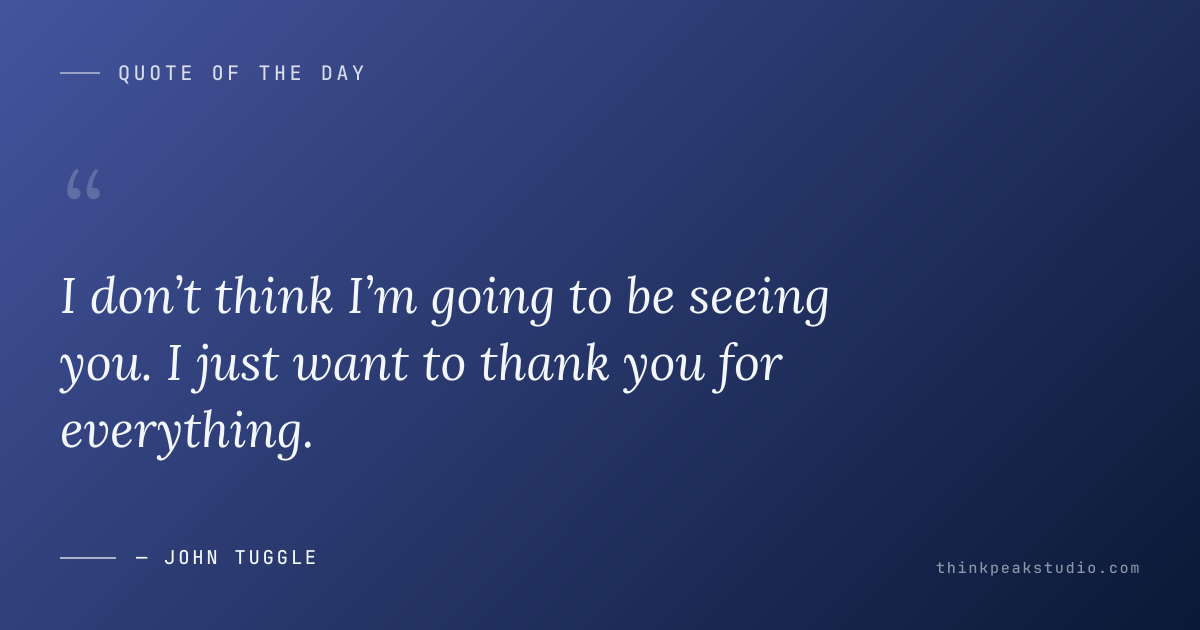
“I don’t think I’m going to be seeing you. I just want to thank you for everything.”
What this quote means
It was the summer of 1986, and John Tuggle knew exactly what he was doing. He had been fighting an angiosarcoma — a rare, aggressive cancer that had settled in his lungs — for two years, and by then the fight was over; everyone could see it but him. He had spent those two years defying the arithmetic, working out with the Giants through his chemotherapy, lifting weights that left even the strongest men staring, refusing the pity that everyone wanted to give him. Now he got himself into a black suit, he polished his shoes, and he walked into the office of the coach who had drafted him last of everybody. He set a brown paper bag on the desk. “Coach, let’s have a drink,” he said, and he opened the bottle of champagne, and then he said the sentence that has outlived every statistic he ever recorded: “I don’t think I’m going to be seeing you. I just want to thank you for everything.”
Read the line cold and it sounds like an ending, but the reason it has travelled four decades is that it is actually a finish in the best sense of the word — a life closing the way a well-run season closes. Tuggle did not spend his last visit complaining, or bargaining, or pretending. He spent it saying thank you. He had been handed the cruelest title in sports — “Mr. Irrelevant,” the name given to the final pick of the draft — and he had answered it by becoming the first last pick in history to make his team’s roster, by earning the vote of his teammates as special teams player of the year, and then, when football was taken from him, by becoming the standard his conditioning coach measured everyone against. “In the weight room, John Tuggle was not sick,” Johnny Parker said. “John Tuggle was a standard.” The champagne was not a surrender. It was a receipt: a man who had been told he was irrelevant, and who had proved the opposite every single day, saying the only thing that still needed saying.
The deeper lesson hiding in the sentence is about timing. Gratitude is easy to postpone — there will always be a next season, a next visit, a next chance to say the thing. Tuggle, who spent his last two years believing he would play again, was nevertheless clear-eyed enough to know that some conversations cannot wait. He went to Parcells not because the coach needed to hear it but because he needed to say it, cleanly, in person, with both of them fully present. That is what the black suit was for. That is what the champagne was for. He understood what almost everyone learns too late: the thank-you is not a formality at the end of a relationship, it is the point of it — and the people who change our lives deserve to hear it before the office visit that is also a goodbye.
And so the quote is not really about dying at all. It is about finishing well, whatever your fight looks like — a job you are leaving, a team you are aging out of, a chapter closing. Tuggle could have been bitter; he had more reason than almost anyone. Instead he chose the one thing a man in his position still fully controls: how he leaves. He made his last act an act of thanks, and in doing so he did what he had done with the label “irrelevant” ten years earlier — he took something the world hands you and turned it into the opposite. Parcells, who has coached a hundred players, has said Tuggle was among the few who made him wonder whether he could do what Tuggle did, endure and still want to pour champagne. Forty years later, on a September morning when a movie trailer sent millions of people to his story, that is still the question Tuggle’s life asks of every one of us: when your last meeting comes, what will you have left unsaid?
About John Tuggle
John Davis Tuggle was born on January 13, 1961, in Honolulu, Hawaii, and grew up in San Jose, California, where he played football at Independence High School — the school still holds an annual golf tournament in his memory. He went on to play four seasons for the California Golden Bears as their starting fullback, rushing for 1,813 yards and 16 touchdowns while also catching 108 passes for 914 yards and three scores. He won a starting job in the fourth game of his true freshman season in 1979 and helped Cal reach the Garden State Bowl, the school’s first bowl appearance since 1959. In 1980 he rushed 27 times for 110 yards and two touchdowns as the Bears upset John Elway’s heavily favored Stanford team 28–23. His senior season of 1982, in which he led the team in rushing, ended in the wild finale to Stanford forever known as “The Play” — a game in which Tuggle’s 28 carries for 97 yards were, for once, the second-most famous thing that happened on the field.
In the 1983 NFL Draft, the New York Giants used their final selection — 335th overall, the last pick in the entire draft — on Tuggle, making him that year’s “Mr. Irrelevant.” What happened next is why the label never fits: he was the first Mr. Irrelevant in NFL history to make the roster of the team that drafted him. In Bill Parcells’s first season as head coach — a 3–12–1 year for a young Giants team — Tuggle played all 16 games, mostly on special teams, before being promoted to starting fullback in week 12 when Rob Carpenter was injured. He finished the season with 17 carries for 49 yards and a touchdown, three receptions for 50 yards, and 156 kick-return yards, and his teammates voted him the Giants’ Special Teams Player of the Year. By every measure that matters in a locker room, the last pick in the draft had become one of the most respected men on the team.
The offseason that followed took almost everything from him. He went through a divorce, suffered a knee injury in a workout that required surgery, and then, one summer day, he was in a minor car crash with some teammates when their vehicle struck a telephone pole. The collision was barely a fender-bender, but Tuggle kept complaining of a pain in his shoulder that felt far worse than such an accident should explain. At the urging of Carpenter, who had been in the car with him, he saw a doctor — and learned he had cancer. Instead of leaving the team, he stayed, working out through rounds of chemotherapy, hoping he would somehow return to the field. His conditioning coach remembered him vividly: “In the weight room, John Tuggle was not sick. John Tuggle was a standard.” The Giants, rather than cutting him, advised him not to report to training camp in 1985 so he could keep collecting his salary until his contract expired in February 1986. When he was gone for good, they paid his health insurance for the rest of his life — and they wore his number 38 on their helmets all through the 1986–87 season, the year they won the Super Bowl.
In the final months of his life, Tuggle moved back in with Steve Cacciari, his college roommate at Cal, telling him he wanted to die in California. He spent his last weeks getting treatment in San Diego and Mexico, and he spent one of them water-skiing at 30 miles an hour behind his new boat, in a wetsuit, hair coming out in clumps, refusing to let go of the tow rope. “John thought he was bulletproof; he just wanted to live so bad,” Cacciari said. On August 30, 1986, at a cancer clinic in Tijuana, he died in his sleep, at 25. His story has been told in the ESPN 30 for 30 short The Irrelevant Giant, and this winter it arrives on the big screen: Mr. Irrelevant: The John Tuggle Story, starring David Corenswet as Tuggle and Michael Shannon as Parcells, opens December 25, 2026. When its first trailer dropped on September 13, his Wikipedia page — which typically drew only a few hundred views a day — exploded to 175,760 views, then 334,076 the next day. A man once called irrelevant has become one of the most-read stories of the week, and the sentence people keep quoting is the one he chose for his goodbye.
Create your own quote graphic with this quote
A line this tender needs a restrained, dignified frame — deep twilight blues that echo the Giants’ colors, a centered italic serif, and generous whitespace so the sentence can breathe the way Tuggle’s final visit did. If you want to make a quote card from this — or any quote — Quotes Creator gives you the fonts, gradients, backgrounds, and export sizes to do it in minutes, ready for Instagram, Stories, Pinterest, and everywhere else.
Editor’s note
John Tuggle is one of the most-read people on the internet this week. His Wikipedia page, which normally drew only a few hundred views a day, surged to 175,760 views on September 13 and then to 334,076 on September 14 — more than a thousand times its usual traffic — after Paramount released the first trailer for Mr. Irrelevant: The John Tuggle Story, the David Corenswet biopic that opens Christmas Day. We are featuring this quote because it is the whole of his life in one sentence: the man the draft called irrelevant turned every label into its opposite, and when his last meeting came, he chose gratitude. It is a lesson in finishing well — the black suit, the champagne, the thank-you that cannot wait. Before your next goodbye — to a job, a team, a city, a person — ask the question Tuggle’s life answers with a bottle of champagne: what do you still need to say, and why are you waiting?
— ThinkPeak Studio Editorial Team
Tips for designing this quote
- ✓ Use deep twilight blues and steel grays to echo the Giants’ colors and the quiet dignity of the moment
- ✓ Keep the text centered and italic in a serif font so the line reads like a farewell spoken softly, not a headline
- ✓ Break the quote so that the two clauses — “I don’t think I’m going to be seeing you” and “I just want to thank you for everything” — land on their own lines as the beat of the goodbye
- ✓ Add a subtle gradient background rather than a flat color to suggest the weight of a life lived fully in a short time
- ✓ Export in square format for Instagram feed and portrait for Stories or Pinterest
Create your own quote graphic with this quote
Turn this line into a shareable graphic in seconds — free, no signup needed. For video quotes and 100+ templates, try the Android app.
Advertisement
Enjoyed this article? Get more like it in your inbox.


